In the last post, we looked at the Highland Park Industrial track, located near the top edge of the Google Maps image to the right. Today, we'll continue moving clockwise and talk about the Detroit Terminal East Industrial Track. This is the longest stretch of original DTRR trackage still in use by Conrail today.
To the left is a Google satellite imagery showing a slightly closer view of the East Industrial Track. The line begins at the top left, at the same junction where the Highland Park Industrial track branches off from Conrail's North Yard Branch at CP Bonita. Once again, you may be able to see part of North Yard at the very edge of the photo.
The Detroit Terminal rails go south at first, then curve eastward at the junction with the Belt Line Industrial Track. More on the Belt Line in the next post. The line then heads southeast, past the other PVS Nolwood facility in Metro Detroit. You may recall the other facility is also served by Conrail on the Union Branch west of the city. Next up is the Chrysler Jefferson North plant, which is the real reason for the existence of the East Industrial Track. This Chrysler plant is Conrail's largest customer in the Detroit area, according to a recent article in the October 2012 issue of Trains magazine. The line continues southeast toward the Detroit River, serving two smaller industries before reaching the water's edge.
We're back at CP Bonita in the photo above, the intersection of North Yard (top left), the Highland Park Industrial track (top right), the North Yard Branch (bottom right) and the Detroit Terminal Industrial Track (bottom left). For reference, North is to the right in this image.
Moving south slightly, there are a few interesting items to note in the image to the right. First, there's the small classification yard near the top of the photo, which is the northern end of North Yard. The tracks farthest from the camera appear to be RIP tracks, judging from the cars spaced out so that workmen can perform repairs. Second, there's the crossing just below the yard, where the East Industrial Track crosses the Canadian National Mount Clemens Subdivision. The East Industrial Track runs straight north-south, and the CN runs diagonally across.
Once again, we move southward slightly (that's the East Industrial Track/CN crossing at the right) and we see the switch where the Belt Line Industrial Track begins. It continues directly to the south, while the East Industrial Track begins curving eastward.
Moving a couple miles eastward, this is the old Hudson Motors Gratiot Avenue plant. There are rail spurs there in the weeds, but they've been out of use for a long time.
Right next door to the old Hudson plant is the PVS Nolwood plant, as noted earlier, the second of two in the Detroit area and both served by Conrail (or, in my version of reality, the Detroit Terminal). To the left is a Google satellite image in which I've highlighted all of the tracks serving the plant. In this overview, you can see the spurs on both sides of the main line.
Here's a closer view from Bing Maps, facing south to better show the trackage at the back of the plant. It's a fairly complex layout, involving several switchbacks in a confined space. Here are a couple even closer views:
Above, you can see the complex switchbacks at the rear of the complex, and to the left, three additional spots just around the corner.
Here's the other half of the PVS Nolwood operation on the east side of the Conrail main line. There's probably more trackage than on the west side, but it's less complex. What we have here are a couple load out spots next to the white storage tanks and a small yard to store and sort cars for the whole PVS operation.
The way the whole PVS Nolwood operation fans out from the main line, this industry could be challenging to model. However, the operational complexity would make a big contribution to the overall operations of the model railroad, so this is a priority to include.
Continuing southeast toward the river, there is this neat triangular building at the intersection of St. Jean and Shoemaker. It may or may not have been rail served at one time, but that's not really the point. Given the space and time, it's going on the layout.
Next up is Mack Yard and Chrysler's Jefferson North Plant. As noted earlier, this is Conrail Shared Assets' largest customer in Detroit. Jeep Grand Cherokees and Dodge Durangos are built here and shipped out to the rest of the world via autoracks. In the image at right, the factory buildings immediately to the east of Mack Yard are actually the old Budd Co. factory, most recently purchased by Thyssen Krupp and shuttered in 2006.
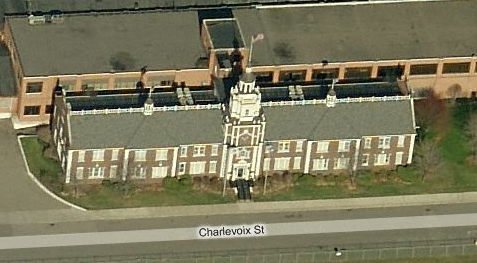
One interesting note is that the original builder of this factory, the Liberty Motor Company, built a replica of Philadelphia's Liberty Hall as it's front offices. The building still fronts Charlevoix St.
In the photo above, we're looking east over Mack Yard with the Budd plant just beyond. The first eleven tracks - those closest to the Budd plant - appear to be used for storage and some minor classification. The next eleven tracks - split into a group of four and then another seven - are dedicated to loading the autoracks. You can also see tracks curving away from Mack Yard to the west, which as you can see in the overview of the entire plant above, hem in the west edge of the Chrysler property. Two of the three tracks bordering the property appear to be used for storage, while one continues south.
Here we have two industries. The large warehouse on the right is Syncrean U.S., and (barely visible) to the left is PSC Environmental Services. There's not much information out there about Syncrean, other than they specialize in logistics for the auto industry. This facility appears to be some kind of transloading facility, with a rail spur entering the warehouse at the north end, and truck docks all around.
This is PSC Environmental Services, who provide hazardous materials clean-up, transportation & disposal. What you see here is what you get - a dilapidated storage building, a couple rudimentary metal shelters and two tank car load-outs. Easy & simple to model, and absolutely oozing character. This is definitely an industry I'd like to include on the Detroit Terminal model.
Before the rails disappear in the weeds at the edge of the Detroit River, we have this interesting little boat yard. As a sailor, this is another detail I'd like to model, given the space.
With that, our tour of the Detroit Terminal East Industrial Track comes to a close. Next up, we'll look at the Belt Line Industrial Track.
Showing posts with label North Yard. Show all posts
Friday, October 19, 2012
Saturday, August 11, 2012
Highland Park Industrial Track
In my last post, I looked at the Conrail Union Branch, which forms the western limit of the DTRR on the map at the left. After traveling north from Dearborn, the right-of-way turns east and terminates before reaching the kink where the tracks turn slightly northeast. Before the original DTRR was abandoned, this "kink" is where the west end of the DTRR interchanged with the Pennsylvania Railroad's Union Branch, and the latter railroad ended. The DTRR continued northeast through Highland Park, turned briefly eastward, and then south to the the Grand Trunk Western's North Yard. Conrail tore up the entire northeasterly section between the Union Branch and what is now called the Highland Park Industrial Track.
Here's a closer view from Google satellite imagery, showing what remains of the Highland Park Industrial Track. In our tour of the line, we'll start just north of Conrail's North Yard, at a complex junction called CP Bonita.
In the image from Bing Maps Bird's Eye view to the left, we are looking eastward at CP Bonita, with the northern tip of Conrail North Yard at the left edge of the picture. The double-tracks running due north are the Conrail North Yard Branch/Sterling Secondary. The Highland Park Industrial Track diverges northwest from the North Yard Branch, curving out of the top right corner of this photo. You may also be able to see another track diverging southeast from the North Yard Branch trackage, which is the Detroit Terminal East Industrial Track. More on the latter in another post, but at one time the Highland Park and Detroit Terminal East industrial tracks weren't separate branches, but the continuous main line of the Detroit Terminal Railroad's East End. The DTRR crossed the Michigan Central and Grand Trunk Western tracks, and a large volume of traffic was interchanged between DTRR's Davison Yard and both the Michigan Central North Yard and Grand Trunk Western East Yard. The latter two yards were nearly indistinguishable; appearing instead to be one humongous yard smack dab in the middle of the Hamtramck neighborhood.
Just to the northeast, the Highland Park Industrial Track bisects the intersection of Mt. Elliot Street and McNichols Road. Federal Pipe & Supply (the green building on the bottom right) and Merit Auto Parts & Salvage (the yellow and white building at the top left) are not rail-served, but would be great models. This scene wouldn't be a priority, but given sufficient space, its inclusion would impart a lot of Detroit character. Just look at the Google Streetview photos of these two structures:
This is the Mound Correctional Facility, which stands on the site of the former DTRR Davison yard. This was the main classification yard of the DTRR, taking in rail traffic from both of its parent railroads - the Michigan Central and Grand Trunk Western - and routing cars all over Detroit. There was a roundhouse here, left over from the days of steam, as well as the DTRR's main offices. It had become dilapidated in its final days, with several stalls open to the elements after a fire.
The yard lead crossed a tangle of roads on the eastern edge of the yard, including Davison Street (from which the yard got its name) and Mound Road, which I'm sure caused many a traffic snarl!
This is the same intersection today, but trains pass by infrequently and without much notice.
Just across the tracks from the Mound Correctional Facility is Alpha Resins, which features an interesting track layout. Consider that any train switching this industry (and the others nearby) will come from North Yard, traveling from right to left in this picture, with the locomotive in the lead. While Alpha Resins' spur off the main track looks like a simple trailing point affair, if the engineer simple backs the train into the spur, his locomotive is now in the way for the switchback into the plant itself. To deliver cars to the customer, the crew must use the Jailhouse siding to run around the train and lead the train into the spur engine-first. Then the crew can back the cars into the appropriate spots among the three spurs within the plant. If that's not enough, consider that the crew will likely need to pull cars out of the plant before delivering new ones, and you've got a lot of work to do!
Here's another view, using Bing Maps' Birds Eye view, from the trackside. I count at least three places to spot cars: first, at the left-most set of tanks; second, at the larger group of white tanks near the top right corner of this image; third, at the small group of rusty-looking tanks near the bottom of the photo. In addition, it looks like additional cars could be stored (or possibly spotted) along the spur that runs in front of the tall building near the bottom right corner of the photo. Lastly, the roll-up doors in the long, low building on the left side of the photo could be car spots too.
All in all, there's a lot going on here; Alpha Resins is definitely a high priority to model on the DTRR.
Across Ryan Road, just east of Alpha Resins, is another interesting set of industries. First is Metropolitan Alloys Corporation, which produces zinc alloys and aluminum products. Right next door is Winston Brothers Iron & Metal, one of many scrap metal recyclers in Detroit.
I wasn't entirely certain that Metropolitan Alloys was still rail-served, but then I stumbled upon the image at left using Bing Maps. Sure enough, that's a 50' boxcar spotted at one of the building's roll-up doors.
Here's Winston Brothers Iron & Metal from roughly the same perspective. It's hard to see in this view, but you can just make out the spur curving to the southeast among the rusting hulks and cranes. You may also be able to see two empty gondolas sitting on the Metropolitan Alloys spur, waiting to be spotted in the Winston Brothers yard for loading.
I dig the sign painted on the building and the battered chain link fence. Even if it weren't for the fact that scrap metal is a key industry in Detroit, I'd include this scene in my model of the DTRR for sheer character.
Google sayeth the track endeth here, though Bing disagrees, and shows satellite imagery of the DTRR tracks continuing all the way to Ford Junction, where the Detroit Terminal crossed the CN (GTW) Holly Subdivision.
Both the DTRR and one of its parents, the GTW, served the large Ford Highland Park plant here. It was here that the first assembly line was used for mass production of the famous Model T automobile. Most of the plant is now shut down.
The last point of interest is the DTRR overpass over Woodward Avenue. Woodward was the main road from downtown Detroit to Pontiac, MI, and every year the Woodward Dream Cruise is held along its entire length. Classic American cars of nearly every description cruise continuously, while scores more park in every parking lot, driveway and sidewalk along the route. Though not a priority, given the space, I'd try to model this craziness in 1:87 just for kicks. Plus, I think the bridge looks pretty neat.
In my next post, I'll take a look at the Detroit Terminal East Industrial Track, mentioned near the beginning of this post. As always, thanks for reading.
Here's a closer view from Google satellite imagery, showing what remains of the Highland Park Industrial Track. In our tour of the line, we'll start just north of Conrail's North Yard, at a complex junction called CP Bonita.
In the image from Bing Maps Bird's Eye view to the left, we are looking eastward at CP Bonita, with the northern tip of Conrail North Yard at the left edge of the picture. The double-tracks running due north are the Conrail North Yard Branch/Sterling Secondary. The Highland Park Industrial Track diverges northwest from the North Yard Branch, curving out of the top right corner of this photo. You may also be able to see another track diverging southeast from the North Yard Branch trackage, which is the Detroit Terminal East Industrial Track. More on the latter in another post, but at one time the Highland Park and Detroit Terminal East industrial tracks weren't separate branches, but the continuous main line of the Detroit Terminal Railroad's East End. The DTRR crossed the Michigan Central and Grand Trunk Western tracks, and a large volume of traffic was interchanged between DTRR's Davison Yard and both the Michigan Central North Yard and Grand Trunk Western East Yard. The latter two yards were nearly indistinguishable; appearing instead to be one humongous yard smack dab in the middle of the Hamtramck neighborhood.
Just to the northeast, the Highland Park Industrial Track bisects the intersection of Mt. Elliot Street and McNichols Road. Federal Pipe & Supply (the green building on the bottom right) and Merit Auto Parts & Salvage (the yellow and white building at the top left) are not rail-served, but would be great models. This scene wouldn't be a priority, but given sufficient space, its inclusion would impart a lot of Detroit character. Just look at the Google Streetview photos of these two structures:
This is the Mound Correctional Facility, which stands on the site of the former DTRR Davison yard. This was the main classification yard of the DTRR, taking in rail traffic from both of its parent railroads - the Michigan Central and Grand Trunk Western - and routing cars all over Detroit. There was a roundhouse here, left over from the days of steam, as well as the DTRR's main offices. It had become dilapidated in its final days, with several stalls open to the elements after a fire.
The yard lead crossed a tangle of roads on the eastern edge of the yard, including Davison Street (from which the yard got its name) and Mound Road, which I'm sure caused many a traffic snarl!
This is the same intersection today, but trains pass by infrequently and without much notice.
Just across the tracks from the Mound Correctional Facility is Alpha Resins, which features an interesting track layout. Consider that any train switching this industry (and the others nearby) will come from North Yard, traveling from right to left in this picture, with the locomotive in the lead. While Alpha Resins' spur off the main track looks like a simple trailing point affair, if the engineer simple backs the train into the spur, his locomotive is now in the way for the switchback into the plant itself. To deliver cars to the customer, the crew must use the Jailhouse siding to run around the train and lead the train into the spur engine-first. Then the crew can back the cars into the appropriate spots among the three spurs within the plant. If that's not enough, consider that the crew will likely need to pull cars out of the plant before delivering new ones, and you've got a lot of work to do!
Here's another view, using Bing Maps' Birds Eye view, from the trackside. I count at least three places to spot cars: first, at the left-most set of tanks; second, at the larger group of white tanks near the top right corner of this image; third, at the small group of rusty-looking tanks near the bottom of the photo. In addition, it looks like additional cars could be stored (or possibly spotted) along the spur that runs in front of the tall building near the bottom right corner of the photo. Lastly, the roll-up doors in the long, low building on the left side of the photo could be car spots too.
All in all, there's a lot going on here; Alpha Resins is definitely a high priority to model on the DTRR.
Across Ryan Road, just east of Alpha Resins, is another interesting set of industries. First is Metropolitan Alloys Corporation, which produces zinc alloys and aluminum products. Right next door is Winston Brothers Iron & Metal, one of many scrap metal recyclers in Detroit.
I wasn't entirely certain that Metropolitan Alloys was still rail-served, but then I stumbled upon the image at left using Bing Maps. Sure enough, that's a 50' boxcar spotted at one of the building's roll-up doors.
Here's Winston Brothers Iron & Metal from roughly the same perspective. It's hard to see in this view, but you can just make out the spur curving to the southeast among the rusting hulks and cranes. You may also be able to see two empty gondolas sitting on the Metropolitan Alloys spur, waiting to be spotted in the Winston Brothers yard for loading.
I dig the sign painted on the building and the battered chain link fence. Even if it weren't for the fact that scrap metal is a key industry in Detroit, I'd include this scene in my model of the DTRR for sheer character.
Google sayeth the track endeth here, though Bing disagrees, and shows satellite imagery of the DTRR tracks continuing all the way to Ford Junction, where the Detroit Terminal crossed the CN (GTW) Holly Subdivision.
Both the DTRR and one of its parents, the GTW, served the large Ford Highland Park plant here. It was here that the first assembly line was used for mass production of the famous Model T automobile. Most of the plant is now shut down.
The last point of interest is the DTRR overpass over Woodward Avenue. Woodward was the main road from downtown Detroit to Pontiac, MI, and every year the Woodward Dream Cruise is held along its entire length. Classic American cars of nearly every description cruise continuously, while scores more park in every parking lot, driveway and sidewalk along the route. Though not a priority, given the space, I'd try to model this craziness in 1:87 just for kicks. Plus, I think the bridge looks pretty neat.
In my next post, I'll take a look at the Detroit Terminal East Industrial Track, mentioned near the beginning of this post. As always, thanks for reading.
Subscribe to:
Posts (Atom)